Learn what is Product-Led Growth (PLG) Marketing is, how it works, its benefits, strategies, examples, and best practices. Discover how SaaS companies use PLG to increase user acquisition, activation, retention, and revenue.
What Is Product-Led Growth (PLG) Marketing?
The SaaS industry has changed dramatically over the last decade. Buyers no longer want lengthy sales calls before they can experience a product. Instead, they expect instant access, intuitive onboarding, and immediate value. This shift has transformed how software companies acquire, convert, and retain customers.
This is where What Is Product-Led Growth (PLG) Marketing becomes one of the most important questions for SaaS founders, marketers, and product teams.
Rather than relying solely on advertising or sales representatives, Product-Led Growth (PLG) uses the product itself as the primary engine for customer acquisition, conversion, and expansion.
Instead of convincing prospects with presentations or demos, businesses allow users to experience the product firsthand through a Free Trial or Freemium Model, enabling them to discover value independently.
Modern SaaS leaders such as Slack, Zoom, Calendly, Notion, Canva, Dropbox, and Figma have demonstrated that when customers can experience value quickly, they are far more likely to become loyal paying users.
Today’s buyers prefer to evaluate software on their own terms. They expect frictionless Self-Service Onboarding, intuitive User Experience (UX), and rapid Time to Value (TTV).
When users reach their first meaningful success—often referred to as the Aha Moment—their confidence in the product grows naturally, leading to higher User Activation, increased Product Adoption, and stronger long-term relationships.
Unlike traditional marketing approaches that focus only on generating leads, Product-Led Marketing uses the product as the primary marketing channel. Every interaction inside the application becomes part of the customer experience, influencing the entire Customer Journey from awareness to advocacy.
As organizations embrace Data-Driven Product Decisions, they continuously analyze Product Analytics, User Behavior Analytics, and Product Usage Data to improve onboarding, optimize feature discovery, and reduce friction throughout the user lifecycle.
In this comprehensive guide, you’ll learn:
- What Product-Led Growth (PLG) Marketing is
- How the PLG model works
- Why leading SaaS companies are adopting it
- The difference between PLG, Sales-Led Growth, and Marketing-Led Growth
- Core PLG metrics and KPIs
- Practical implementation strategies
- Common mistakes to avoid
- Best practices for long-term SaaS growth
Whether you’re launching a startup or scaling an established SaaS business, understanding What Is Product-Led Growth (PLG) Marketing can help you build a more efficient, customer-centric growth engine.
What Is Product-Led Growth (PLG) Marketing?
At its core, Product-Led Growth (PLG) is a business methodology where the product itself becomes the primary driver of customer acquisition, activation, conversion, retention, and expansion.
Instead of persuading prospects through lengthy sales conversations, organizations allow users to experience the software before making a purchase decision.
In simple terms, the product becomes your best salesperson.
Product-Led Marketing extends this philosophy by designing marketing campaigns that encourage prospects to interact directly with the product rather than relying solely on promotional content. Instead of asking users to “Book a Demo,” PLG companies invite them to “Start Free,” making the path to value significantly shorter.
This approach reduces friction and enables users to evaluate software independently. As they interact with key features, effective User Onboarding and In-Product Guidance help them understand the product’s value quickly, increasing the likelihood of reaching their first Aha Moment.
For example, a project management platform might allow new users to create their first workspace, invite teammates, and complete a task within minutes. That initial success improves the Activation Rate, strengthens User Engagement, and accelerates Trial-to-Paid Conversion.
The effectiveness of PLG depends on how well the product delivers value without requiring constant human intervention. Every touchpoint—from signup to advanced feature discovery—must be optimized to reduce friction and encourage continued use.
A successful PLG company typically focuses on:
- Fast Self-Service Onboarding
- Exceptional User Experience (UX)
- Short Time to Value (TTV)
- Continuous Feature Adoption
- Personalized In-Product Guidance
- Strong Product Adoption
- Intelligent Product Feedback Loops
- Seamless upgrade paths through Usage-Based Upselling
Instead of measuring success only by lead volume, PLG organizations evaluate how effectively users progress through the product experience.
Why Product-Led Growth Is Transforming SaaS Marketing
Software buyers have become increasingly independent. Before speaking with a sales representative, they expect to research products, compare alternatives, and test software on their own.
This shift has fundamentally changed SaaS buying behavior.
Traditional marketing often focuses on attracting leads through paid advertising, webinars, downloadable resources, and email campaigns. While these methods remain valuable, they may introduce friction by delaying the user’s ability to experience the product.
PLG removes much of that friction.
Rather than asking users to trust marketing promises, companies let the product demonstrate its value directly. This creates a more authentic buying experience and often reduces Customer Acquisition Cost (CAC) while improving Customer Lifetime Value (CLV).
When customers experience meaningful value early, they are more likely to remain engaged, recommend the product to others, and expand their usage over time.
This creates a powerful growth cycle:
- Users discover the product.
- They complete Self-Service Onboarding.
- They experience an Aha Moment.
- User Activation increases.
- Product Adoption grows.
- More users invite teammates through Viral Loops.
- Team collaboration strengthens Network Effects.
- Organizations expand usage using a Land-and-Expand Strategy.
- Revenue grows through Customer Expansion and Expansion Revenue.
Companies embracing this model often experience higher efficiency because satisfied users naturally become advocates for the product.
How Product-Led Growth (PLG) Marketing Works
Understanding What Is Product-Led Growth (PLG) Marketing becomes easier when you look at the complete customer lifecycle.
1. Customer Acquisition
Prospective users discover your software through SEO, content marketing, referrals, communities, social media, paid advertising, or partner ecosystems.
Unlike traditional funnels, the goal is to move prospects directly into the product rather than scheduling a sales meeting.
The product itself becomes the first meaningful interaction.
2. Self-Service Product Experience
Instead of waiting for approval or a demo, users sign up instantly through a Free Trial or Freemium Model.
The registration process should require minimal effort while maintaining security and personalization.
Removing unnecessary friction increases signup completion and encourages exploration.
3. User Onboarding
Effective User Onboarding introduces users to the product gradually.
Rather than overwhelming them with dozens of features, successful PLG companies prioritize Feature Prioritization, presenting only the functionality necessary to help users achieve their first success.
Interactive walkthroughs, progress checklists, tooltips, and contextual In-Product Guidance all contribute to a smoother experience.
4. User Activation
Once users complete key actions, they become activated.
Common activation events include:
- Creating a first project
- Uploading a document
- Inviting teammates
- Publishing content
- Connecting integrations
- Completing setup
The percentage of users reaching these milestones determines the overall Activation Rate.
5. Product Adoption
Activated users begin exploring additional capabilities.
As they discover advanced functionality, Feature Adoption increases, creating deeper engagement with the platform.
This stage is heavily influenced by:
- Personalized recommendations
- Educational resources
- Contextual guidance
- Behavioral segmentation
- Intelligent notifications
6. Data-Driven Optimization
PLG organizations continuously evaluate:
- Product Analytics
- User Behavior Analytics
- Digital Analytics
- Product Usage Data
These insights enable teams to identify friction points, improve onboarding, refine messaging, and make Data-Driven Product Decisions that enhance the overall customer experience.
Cross-functional collaboration between marketing, product, sales, customer success, and engineering ensures improvements benefit the entire Customer Journey.
When every department works toward shared goals, organizations achieve stronger Cross-Functional Alignment and build a sustainable Product-Led Organization.
7. Conversion and Expansion
Not every user becomes a customer immediately.
Instead, high-intent users who demonstrate meaningful engagement often become Product-Qualified Leads (PQLs). These users have already experienced value and are significantly more likely to convert than traditional marketing leads.
Sales teams can then apply Product-Led Sales (PLS) strategies by engaging only the most qualified users, improving efficiency while maintaining a personalized buying experience.
Over time, satisfied customers upgrade plans, purchase additional seats, adopt premium features through Usage-Based Upselling, and contribute to long-term Revenue Growth.
This continuous cycle supports sustainable SaaS Growth Strategy, increases Conversion Rate, improves Customer Retention, and strengthens the business through recurring subscription revenue.
As more organizations experience success, positive feedback encourages referrals, reviews, and advocacy—reinforcing the entire PLG ecosystem.
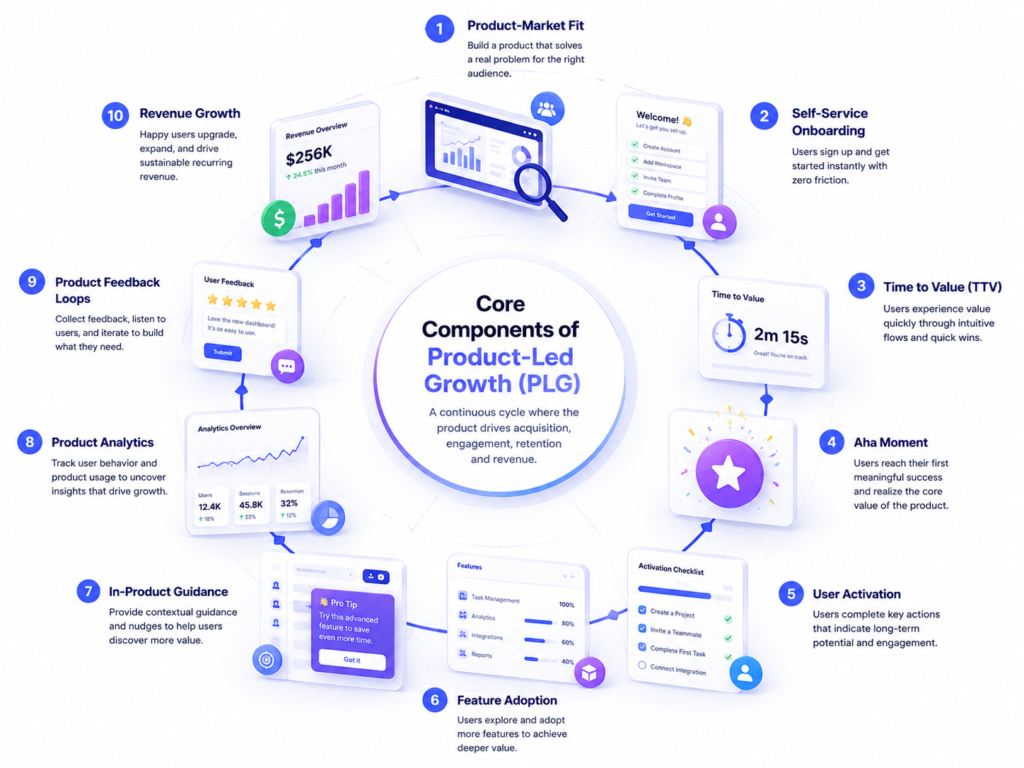
Core Components of a Successful Product-Led Growth (PLG) Strategy
Now that you understand What Is Product-Led Growth (PLG) Marketing, the next question is how successful SaaS companies actually implement it.
Many businesses mistakenly believe that simply offering a Free Trial or Freemium Model makes them product-led. In reality, those are only entry points. A true Product-Led Growth (PLG) strategy requires every department—from product and marketing to sales and customer success—to work together around one common goal: helping users achieve value as quickly as possible.
A successful PLG company continuously improves every stage of the customer lifecycle using customer insights, behavioral data, experimentation, and collaboration.
Let’s explore the essential building blocks.
1. Product-Market Fit: The Foundation of Product-Led Growth
No PLG strategy succeeds without Product-Market Fit.
Before investing in marketing campaigns or scaling customer acquisition, your product must solve a meaningful problem for a clearly defined audience.
When customers genuinely need your solution, marketing becomes significantly easier because satisfied users naturally recommend the product to others.
Strong indicators of Product-Market Fit include:
- High customer satisfaction
- Strong referral rates
- Organic growth
- Repeat usage
- Low churn
- Increasing customer demand
Companies that skip this stage often struggle with low activation, poor retention, and rising acquisition costs.
Instead of asking,
“How can we sell more?”
successful PLG organizations ask,
“How can we make the product so valuable that people naturally want to keep using it?”
That mindset changes everything.
2. Self-Service Onboarding Creates the First Impression
One of the defining characteristics of Product-Led Marketing is frictionless Self-Service Onboarding.
Today’s SaaS buyers don’t want to wait days for product demonstrations.
They want immediate access.
An effective onboarding experience allows users to:
- Create an account instantly
- Import existing data
- Explore features
- Complete meaningful actions
- Experience value within minutes
Great onboarding removes unnecessary complexity while guiding users toward success.
Instead of overwhelming users with dozens of tutorials, leading SaaS companies introduce features progressively.
This approach significantly improves:
- User Onboarding
- User Experience (UX)
- Time to Value (TTV)
- Activation Rate
For example, Slack encourages users to send their first message immediately instead of explaining every available feature. That simple interaction quickly demonstrates the product’s value.
3. Reduce Time to Value (TTV)
One of the most important metrics in Product-Led Growth is Time to Value (TTV).
It measures how long it takes a new user to experience meaningful value after signing up.
The shorter this timeline becomes, the higher your chances of retaining users.
Imagine two project management platforms.
Platform A requires:
- lengthy setup
- manual configuration
- multiple integrations
- complicated permissions
Platform B allows users to create a project and assign tasks within two minutes.
Which product is more likely to keep users engaged?
The answer is obvious.
Reducing Time to Value improves:
- User satisfaction
- Trial completion
- Customer Acquisition efficiency
- Product Adoption
- Customer Retention
Every unnecessary click delays value.
Every simplified interaction increases conversions.
4. Design an Exceptional User Experience (UX)
Even the most powerful software can fail if users find it confusing.
An intuitive User Experience (UX) is one of the strongest competitive advantages in Product-Led Growth.
Great UX includes:
- Clean navigation
- Logical workflows
- Fast loading speed
- Mobile responsiveness
- Accessible interfaces
- Consistent design systems
Good UX also reduces customer support requests because users naturally understand how the product works.
Remember:
People don’t buy features.
They buy outcomes.
The easier those outcomes become, the stronger your PLG strategy becomes.
5. Guide Users Toward Their Aha Moment
Every successful SaaS product has a defining moment when users suddenly understand why the product matters.
This is known as the Aha Moment.
For Dropbox, it was syncing files across devices.
For Zoom, it was joining a video call effortlessly.
For Canva, it was creating professional designs without graphic design skills.
Your onboarding process should intentionally guide users toward this experience.
The faster users reach this milestone, the greater the likelihood of:
- User Activation
- Product Adoption
- Customer Retention
- Paid subscriptions
Companies that delay this moment often lose users before they fully understand the product’s value.
6. Improve User Activation
User Activation occurs when users complete the actions most strongly associated with long-term success.
These activation events differ by product.
Examples include:
- Publishing the first webpage
- Creating a project
- Inviting teammates
- Connecting integrations
- Scheduling meetings
- Uploading documents
Tracking these behaviors helps improve the overall Activation Rate.
Many SaaS companies use onboarding checklists, walkthroughs, and progress bars to encourage completion of these milestones.
Small improvements in activation often produce significant revenue gains later in the customer journey.
7. Encourage Feature Adoption
New customers rarely explore every feature immediately.
Instead, they gradually discover functionality over time.
This gradual exploration is known as Feature Adoption.
Successful SaaS companies prioritize features strategically instead of presenting everything at once.
This process, called Feature Prioritization, ensures users learn the most valuable capabilities first.
Examples include:
- contextual tooltips
- feature announcements
- personalized recommendations
- onboarding checklists
- interactive product tours
Gradual discovery keeps users engaged without overwhelming them.
8. Use In-Product Guidance
Modern SaaS companies increasingly rely on In-Product Guidance rather than static documentation.
Instead of asking users to search a help center, guidance appears exactly when needed.
Examples include:
- onboarding walkthroughs
- interactive tours
- contextual hints
- feature recommendations
- smart notifications
This approach reduces frustration while increasing adoption.
The best products teach users naturally.
9. Measure Everything with Product Analytics
One major advantage of Product-Led Growth is that almost every customer interaction generates measurable insights.
Using Product Analytics, businesses can monitor:
- signups
- active users
- feature usage
- onboarding completion
- session duration
- retention
- upgrades
When combined with User Behavior Analytics, teams gain a much deeper understanding of customer actions.
Rather than making assumptions, companies use actual data.
Additional insights come from:
- Product Usage Data
- Digital Analytics
- heatmaps
- funnel reports
- cohort analysis
Together, these datasets enable smarter Data-Driven Product Decisions that continuously improve the user experience.
10. Build Continuous Product Feedback Loops
Great products never stop evolving.
The best SaaS companies actively collect feedback from:
- surveys
- interviews
- support tickets
- reviews
- feature requests
- in-app ratings
These Product Feedback Loops help teams understand changing customer needs.
Instead of releasing features based solely on internal opinions, companies prioritize improvements using customer insights.
This customer-centric approach strengthens long-term loyalty.
Product-Led Growth (PLG) vs. Marketing-Led Growth (MLG) vs. Sales-Led Growth (SLG)
Understanding What Is Product-Led Growth (PLG) Marketing becomes much easier when comparing it with traditional growth models.
Although all three approaches can generate revenue, they differ significantly in how customers move through the buying journey.
| Factor | Product-Led Growth (PLG) | Marketing-Led Growth (MLG) | Sales-Led Growth (SLG) |
|---|---|---|---|
| Primary Growth Driver | Product | Marketing Campaigns | Sales Team |
| User Access | Instant | Lead Form | Sales Demo |
| First Experience | Product Usage | Content | Sales Call |
| Conversion | Product Experience | Marketing Nurturing | Sales Process |
| Sales Involvement | Minimal | Moderate | High |
| Customer Acquisition Cost (CAC) | Lower | Medium | Higher |
| Scalability | Very High | High | Moderate |
| Best For | SaaS Products | B2B Services | Enterprise Software |
What Is Marketing-Led Growth (MLG)?
Marketing-Led Growth (MLG) focuses on attracting prospects through educational content and promotional campaigns before introducing the product.
Typical MLG channels include:
- SEO
- blogs
- webinars
- email campaigns
- LinkedIn marketing
- paid advertising
- downloadable resources
Marketing generates awareness and captures leads.
Sales then converts those leads into customers.
This model works well for businesses selling complex services that require consultation before purchase.
However, for many SaaS companies, requiring multiple interactions before product access increases friction.
What Is Sales-Led Growth (SLG)?
Sales-Led Growth (SLG) depends heavily on sales representatives guiding prospects through demonstrations, negotiations, and customized proposals.
This model is common among enterprise software providers where purchasing decisions involve multiple stakeholders.
The sales process often includes:
- discovery calls
- product demonstrations
- procurement
- security reviews
- contract negotiations
Although effective for large enterprise deals, SLG generally involves:
- longer sales cycles
- higher operating costs
- greater Customer Acquisition Cost (CAC)
Where Product-Led Sales (PLS) Fits In
Many organizations don’t eliminate sales entirely.
Instead, they adopt Product-Led Sales (PLS).
Rather than contacting every lead, sales teams focus only on highly engaged users who have already demonstrated buying intent.
These high-intent users become Product-Qualified Leads (PQLs).
Unlike traditional Marketing Qualified Leads, PQLs have already experienced value inside the product.
Examples include users who:
- invite teammates
- exceed usage limits
- explore premium features
- integrate external applications
- reach account limits
These behaviors indicate genuine purchase intent.
Sales conversations become shorter because prospects already understand the product.
This combination of PLG and PLS creates a highly efficient revenue engine.
Why Many SaaS Companies Combine All Three Models
Contrary to popular belief, successful SaaS companies rarely rely on a single growth strategy.
Instead, they blend:
- Marketing-Led Growth (MLG) to generate awareness.
- Product-Led Growth (PLG) to let users experience value.
- Product-Led Sales (PLS) to convert high-intent accounts.
- Enterprise Sales-Led Growth (SLG) for complex, high-value deals.
This hybrid approach supports a comprehensive Go-to-Market (GTM) Strategy that aligns marketing, product, sales, and customer success teams.
When these departments share common goals and metrics, they achieve stronger Cross-Functional Alignment, improve collaboration, and build a scalable Product-Led Organization.
Instead of operating in silos, every team contributes to delivering value throughout the customer lifecycle—from initial Customer Acquisition and Product Discovery to long-term Customer Expansion and sustainable Revenue Growth.
Benefits of Product-Led Growth (PLG) Marketing
Now that you understand What Is Product-Led Growth (PLG) Marketing and how a successful PLG strategy is built, it’s time to explore why thousands of SaaS businesses are shifting toward this growth model.
The biggest advantage of Product-Led Growth (PLG) is that it places the customer—not the sales process—at the center of every business decision. Instead of convincing prospects to purchase software based on marketing promises or sales presentations, PLG companies allow users to experience the product firsthand.
This hands-on experience builds trust, accelerates decision-making, and creates stronger customer relationships from the very beginning.
Whether you’re a startup trying to gain traction or an enterprise SaaS company looking to scale efficiently, PLG offers numerous benefits that improve acquisition, conversion, retention, and long-term profitability.
1. Lower Customer Acquisition Cost (CAC)
One of the most compelling reasons businesses adopt Product-Led Marketing is its ability to reduce Customer Acquisition Cost (CAC).
Traditional B2B sales often involve expensive advertising campaigns, lengthy sales calls, product demonstrations, proposal creation, and multiple follow-ups before a prospect becomes a customer. These activities consume significant time and resources.
With a PLG approach, the product itself handles much of the selling process.
Users can sign up through a Free Trial or Freemium Model, explore the platform independently, and determine whether it meets their needs before speaking with a sales representative.
Because customers educate themselves through the product experience, companies spend less on manual sales efforts while acquiring more qualified users.
For example, instead of paying thousands of dollars to generate a single enterprise lead, a SaaS company can attract thousands of users through SEO, content marketing, referrals, and organic product discovery.
As more users experience value, acquisition becomes increasingly efficient, helping businesses scale without proportionally increasing marketing budgets.
2. Faster Time to Value (TTV)
Modern software buyers expect immediate results.
They don’t want to spend hours reading documentation or waiting for onboarding sessions before seeing value.
This is why reducing Time to Value (TTV) is one of the primary goals of every Product-Led Growth strategy.
PLG companies design intuitive workflows that help users accomplish meaningful tasks within minutes of signing up. Features like Self-Service Onboarding, interactive tutorials, onboarding checklists, and contextual In-Product Guidance shorten the learning curve and quickly demonstrate the product’s core value.
The faster users achieve success, the more likely they are to continue using the product, recommend it to colleagues, and eventually become paying customers.
A shorter TTV also reduces user frustration, minimizes drop-offs during onboarding, and improves overall customer satisfaction.
3. Higher User Activation and Product Adoption
Getting users to sign up is only the beginning.
The real challenge is ensuring they actively use the product.
PLG companies focus heavily on increasing User Activation by encouraging customers to complete actions associated with long-term success.
These actions may include creating their first project, inviting teammates, integrating third-party applications, or publishing their first piece of content.
Once users become activated, businesses encourage deeper Product Adoption by introducing advanced capabilities over time.
Instead of overwhelming users with every available feature, successful SaaS companies emphasize Feature Adoption through personalized recommendations, milestone-based learning, and intelligent feature discovery.
This gradual approach helps users build confidence while continuously discovering new value within the platform.
4. Better User Experience (UX)
An outstanding User Experience (UX) is one of the strongest competitive advantages in Product-Led Growth.
Every interaction—from account creation and dashboard navigation to feature discovery and billing—should feel simple, intuitive, and enjoyable.
When software is easy to use, customers require less assistance, support costs decrease, and overall satisfaction improves.
Great UX also contributes to:
- Higher activation rates
- Better engagement
- Faster onboarding
- Reduced abandonment
- Increased product loyalty
Companies that consistently invest in usability often outperform competitors because customers prefer products that solve problems without unnecessary complexity.
5. Increased User Engagement Throughout the Customer Journey
Successful PLG companies continuously encourage User Engagement rather than treating onboarding as a one-time event.
Every stage of the Customer Journey should provide meaningful opportunities for users to discover additional value.
Examples include:
- Product walkthroughs
- Personalized dashboards
- Feature announcements
- Progress tracking
- Usage milestones
- Contextual recommendations
- Interactive tutorials
These experiences keep users engaged long after registration and help prevent stagnation.
Highly engaged users are also more likely to explore premium features, invite colleagues, and upgrade to paid plans.
6. Improved Customer Retention and Churn Reduction
Acquiring customers is expensive.
Keeping them is far more profitable.
One of the greatest advantages of Product-Led Growth is its ability to improve Customer Retention while supporting long-term Churn Reduction.
Customers who consistently experience value are less likely to cancel subscriptions.
PLG companies achieve this by continuously analyzing:
- Product Usage Data
- Product Analytics
- User Behavior Analytics
- Customer feedback
- Feature engagement
These insights help identify friction before it leads to customer dissatisfaction.
For example, if analytics reveal that users who fail to complete onboarding within three days rarely return, the product team can redesign the onboarding flow to improve completion rates.
Small improvements in customer experience often produce significant gains in long-term retention.
7. Data-Driven Product Decisions Lead to Continuous Improvement
Unlike traditional marketing models that rely heavily on assumptions, Product-Led Growth emphasizes measurable behavior.
Every click, interaction, feature usage pattern, and conversion provides valuable insight into customer needs.
Using Digital Analytics, Product Analytics, and User Behavior Analytics, organizations make Data-Driven Product Decisions that continuously optimize the customer experience.
These insights help teams answer important questions such as:
- Which onboarding steps cause users to abandon the product?
- Which features drive the highest retention?
- Which customer segments convert fastest?
- What actions predict long-term success?
- Which workflows need simplification?
Rather than relying on intuition, PLG organizations improve products based on real customer behavior.
8. Higher Trial-to-Paid Conversion Rates
A major goal of Product-Led Marketing is improving Trial-to-Paid Conversion.
When users experience meaningful value during a Free Trial, purchasing becomes a logical next step rather than a difficult sales decision.
Successful SaaS companies optimize trial conversions by:
- Reducing onboarding friction
- Highlighting premium features
- Providing contextual upgrade prompts
- Demonstrating measurable outcomes
- Offering personalized support when needed
As users progress through the Conversion Funnel, they become increasingly confident that the software can solve their problems, making upgrades feel natural rather than forced.
9. More Effective Product-Led Sales (PLS)
One misconception about PLG is that sales teams become unnecessary.
In reality, Product-Led Sales (PLS) complements Product-Led Growth by focusing sales efforts on users who have already demonstrated strong buying intent.
Instead of contacting every signup, sales teams prioritize Product-Qualified Leads (PQLs)—users who actively engage with the product, invite teammates, reach usage limits, or explore premium functionality.
Because these prospects already understand the product’s value, sales conversations become shorter, more relevant, and more successful.
This targeted approach increases productivity while allowing sales representatives to focus on high-value opportunities.
10. Strong Customer Expansion and Expansion Revenue
Product-Led Growth doesn’t stop after the first purchase.
Its real power lies in helping customers grow over time.
As users become more successful, they naturally adopt additional features, purchase premium plans, increase seat counts, and expand usage across departments.
This process drives Customer Expansion and creates recurring Expansion Revenue.
Many SaaS companies support this growth through a Land-and-Expand Strategy, where a single team initially adopts the software before expanding it organization-wide.
For example, one marketing manager may begin using a collaboration platform. After experiencing success, they invite designers, sales representatives, product managers, and executives to join. Over time, the account grows from a single user to hundreds of active seats.
This organic expansion is often more profitable than continuously acquiring new customers.
11. Higher Customer Lifetime Value (CLV)
One of the clearest indicators of a successful PLG strategy is an increase in Customer Lifetime Value (CLV).
Customers who activate quickly, adopt more features, remain engaged, and expand their usage generate significantly more revenue over time.
Companies can further increase CLV by offering:
- Premium plans
- Team subscriptions
- Enterprise features
- Advanced integrations
- Additional storage
- AI-powered capabilities
- Usage-Based Upselling
Because customers already trust the product, these upgrades feel like logical investments rather than aggressive sales tactics.
12. Sustainable Revenue Growth Through Network Effects
The most successful Product-Led companies create self-reinforcing growth systems.
As satisfied users invite teammates, collaborators, and clients, Viral Loops naturally emerge. Many collaboration and communication tools become even more valuable as additional users join, creating powerful Network Effects that strengthen the product over time.
Each new user increases the overall value of the platform, encouraging further adoption and accelerating growth without relying solely on paid marketing.
When supported by continuous Product Discovery, effective onboarding, intelligent feature recommendations, and ongoing optimization, these network-driven experiences contribute to consistent Revenue Growth.
Ultimately, Product-Led Growth is more than a marketing strategy—it’s a long-term SaaS Growth Strategy that aligns every stage of the customer lifecycle around delivering measurable value.
Companies that prioritize customer success, leverage product insights, and maintain strong Net Promoter Score (NPS) often build loyal communities, stronger brands, and predictable recurring revenue.
As organizations evolve into a true Product-Led Organization, every department—from product and marketing to sales and customer success—works together to create exceptional experiences that fuel sustainable business growth.
Challenges of Product-Led Growth (PLG) Marketing
While Product-Led Growth (PLG) has become one of the most effective growth strategies for SaaS companies, implementing it successfully is far from easy.
Many organizations assume that launching a Free Trial or Freemium Model automatically makes them product-led. In reality, PLG requires a company-wide commitment to delivering exceptional customer experiences, leveraging data, and continuously improving the product.
Understanding these challenges before adopting Product-Led Marketing can help you avoid costly mistakes and build a scalable SaaS Growth Strategy.
1. Achieving Product-Market Fit Before Scaling
One of the biggest reasons PLG initiatives fail is that companies attempt to scale before achieving Product-Market Fit.
No amount of marketing, onboarding, or sales optimization can compensate for a product that doesn’t solve a meaningful customer problem.
Before investing heavily in customer acquisition, ask these questions:
- Does the product solve a real pain point?
- Are users returning regularly?
- Do customers recommend the product?
- Is there consistent demand from your target audience?
- Are customers willing to pay for premium features?
If the answer to these questions is “no,” your priority should be improving the product rather than increasing marketing spend.
Best Practice: Validate your product with early adopters, gather feedback frequently, and iterate until customers consistently experience value.
2. Slow Time to Value (TTV)
Today’s software users expect instant results. If your product takes too long to deliver value, users are likely to abandon it before discovering its benefits.
A long Time to Value (TTV) often results from:
- Complicated registration processes
- Lengthy setup requirements
- Confusing navigation
- Poor onboarding experiences
- Too many mandatory configuration steps
For example, imagine a CRM platform requiring users to manually configure pipelines, import contacts, connect email accounts, and customize dashboards before completing a single task. Many users will leave before reaching the Aha Moment.
Solution: Simplify onboarding, use templates, automate setup where possible, and guide users toward meaningful outcomes as quickly as possible.
3. Poor User Onboarding
Your User Onboarding process determines whether users stay or leave.
Many SaaS companies overwhelm new users with dozens of tutorials, complex dashboards, and feature lists immediately after signup.
Instead of educating users, this creates confusion.
Effective onboarding should focus on helping users complete one valuable action at a time.
Successful onboarding experiences typically include:
- Interactive walkthroughs
- Progress checklists
- Contextual tooltips
- Welcome messages
- Guided product tours
- Personalized onboarding paths
Strong Self-Service Onboarding reduces friction while improving User Activation, Activation Rate, and overall customer satisfaction.
4. Low User Activation
Getting thousands of signups means very little if users never experience the product’s value.
Many SaaS businesses celebrate registration numbers while ignoring User Activation.
If users fail to complete key actions—such as creating a project, inviting teammates, or publishing content—they’re unlikely to convert into paying customers.
Low activation often indicates problems with:
- Onboarding
- Product usability
- Feature discoverability
- Messaging
- User expectations
Tracking activation metrics helps identify where users are dropping off in the onboarding process.
Companies should regularly analyze Product Analytics and User Behavior Analytics to identify friction points and improve the overall experience.
5. Feature Overload Reduces Product Adoption
A common misconception is that showcasing every feature increases perceived value.
In reality, too many options can overwhelm users.
This phenomenon, often called “feature overload,” makes it difficult for customers to understand where to begin.
Instead of promoting every capability, focus on Feature Prioritization and encourage gradual Feature Adoption.
Introduce advanced functionality only after users have mastered core features.
Remember:
Users don’t need to know everything on day one.
They only need enough information to achieve success.
6. Ignoring Product Analytics and User Behavior Data
One of the greatest strengths of PLG is access to detailed customer insights.
However, many organizations collect massive amounts of Product Usage Data without acting on it.
Ignoring Product Analytics, Digital Analytics, and User Behavior Analytics leads to missed opportunities for optimization.
For example, analytics may reveal:
- High abandonment during onboarding
- Rarely used features
- Frequently clicked buttons
- Navigation issues
- Popular workflows
- Common support requests
These insights should drive Data-Driven Product Decisions, allowing teams to improve usability and remove unnecessary friction.
Companies that rely solely on assumptions often struggle to improve customer experiences effectively.
7. Weak Product Feedback Loops
Building a successful PLG strategy requires constant learning.
Unfortunately, many businesses only collect feedback after customers cancel their subscriptions.
This reactive approach makes it difficult to improve customer satisfaction.
Strong Product Feedback Loops should include multiple channels for gathering insights, such as:
- In-app surveys
- Customer interviews
- Live chat
- Feature requests
- Community discussions
- Support tickets
- Net Promoter Score (NPS) surveys
Regular feedback helps teams understand evolving customer expectations and identify opportunities for innovation before competitors do.
8. Misalignment Between Teams
PLG is not solely the responsibility of the product team.
Success depends on effective Cross-Functional Alignment between marketing, product, engineering, customer success, and sales.
Without shared goals, departments often optimize for different metrics.
For example:
- Marketing focuses on signups.
- Sales focuses on closed deals.
- Product focuses on feature releases.
- Customer success focuses on retention.
While each objective is valuable, they should contribute to one unified customer experience.
Leading SaaS companies build a Product-Led Organization where every department shares responsibility for customer success and long-term growth.
9. Treating Every User the Same
Not all customers have identical needs.
A startup founder evaluating software behaves differently than an enterprise procurement team.
Ignoring customer segmentation often results in generic onboarding experiences and lower engagement.
Instead, personalize experiences based on:
- Industry
- Company size
- Job role
- Use case
- Team size
- Product behavior
Personalization improves User Engagement, accelerates Product Adoption, and creates more meaningful customer experiences.
10. Focusing Only on Customer Acquisition
Many SaaS companies invest heavily in Customer Acquisition while neglecting retention.
Acquiring new users is important, but sustainable growth depends on keeping existing customers satisfied.
Successful PLG companies continuously optimize:
- Customer Retention
- Customer Expansion
- Expansion Revenue
- Usage-Based Upselling
Long-term customers generate significantly more revenue than one-time conversions.
A balanced strategy focuses on the entire customer lifecycle rather than just acquiring new users.
Common Mistakes to Avoid in Product-Led Growth
Even organizations with strong products can struggle if they make avoidable implementation mistakes. Below are some of the most common pitfalls that slow growth and reduce customer satisfaction.
Mistake #1: Launching PLG Without a Clear Go-to-Market Strategy
Many companies assume the product alone will generate growth.
In reality, PLG works best when combined with a well-defined Go-to-Market (GTM) Strategy.
Marketing, product, customer success, and Product-Led Sales (PLS) should work together to create a seamless buying experience.
Mistake #2: Measuring Vanity Metrics Instead of Business Outcomes
Large signup numbers may look impressive, but they don’t always translate into business success.
Instead of focusing solely on registrations, monitor metrics that indicate real customer value, including:
- Activation Rate
- Trial-to-Paid Conversion
- Customer Lifetime Value (CLV)
- Customer Acquisition Cost (CAC)
- Revenue Growth
- Net Promoter Score (NPS)
These KPIs provide a more accurate picture of long-term business performance.
Mistake #3: Ignoring Product-Qualified Leads (PQLs)
Every user does not require sales assistance.
However, highly engaged users often benefit from timely support.
Identify Product-Qualified Leads (PQLs) based on behaviors such as:
- Inviting teammates
- Reaching usage limits
- Exploring premium features
- Integrating third-party applications
- Frequent product usage
Sales teams using Product-Led Sales (PLS) can prioritize these high-intent accounts, resulting in higher conversion rates and shorter sales cycles.
Mistake #4: Delaying the Aha Moment
If users fail to recognize the product’s value quickly, they are unlikely to remain engaged.
Every onboarding flow should guide users toward the Aha Moment as early as possible.
The faster customers experience success, the greater the chances of long-term loyalty, increased Conversion Rate, and stronger retention.
Mistake #5: Neglecting Customer Expansion Opportunities
The customer journey doesn’t end after the first subscription.
Many SaaS businesses overlook opportunities for Customer Expansion through premium features, additional seats, and advanced capabilities.
A well-executed Land-and-Expand Strategy encourages organizations to start small, demonstrate value, and gradually increase adoption across departments.
Combined with thoughtful Usage-Based Upselling, this approach generates sustainable recurring revenue while strengthening customer relationships.
Product-Led Growth (PLG) Best Practices: Build a Scalable Product-Led Organization
Successfully implementing What Is Product-Led Growth (PLG) Marketing requires more than launching a Free Trial or redesigning your onboarding flow. The most successful SaaS companies continuously optimize every stage of the customer lifecycle, ensuring that users receive value quickly while the business collects actionable insights for ongoing improvement.
The following best practices can help your organization build a sustainable Product-Led Growth engine that drives recurring revenue, improves customer satisfaction, and supports long-term business success.
1. Put Customer Value Before Revenue
One of the biggest differences between traditional SaaS businesses and successful PLG companies is their primary objective.
Traditional organizations often focus on closing deals first.
Product-led organizations focus on delivering customer value first.
When users consistently achieve positive outcomes, revenue naturally follows.
Instead of asking:
“How can we sell more?”
Ask:
- How can we help users succeed faster?
- Which feature solves their biggest problem?
- What prevents customers from achieving success?
- How can we remove friction?
Every improvement that increases customer success contributes to better business outcomes.
2. Optimize Every Step of the Customer Journey
A Product-Led Growth strategy doesn’t end after signup.
Every stage of the Customer Journey should guide users toward deeper engagement and greater value.
An optimized PLG journey typically looks like this:
Discovery → Signup → Self-Service Onboarding → User Activation → Aha Moment → Product Adoption → Feature Adoption → Paid Subscription → Customer Retention → Customer Expansion → Advocacy
Each stage should have measurable goals and performance metrics.
For example:
| Customer Journey Stage | Primary Goal |
|---|---|
| Visitor | Account Signup |
| New User | Complete Onboarding |
| Activated User | Reach Aha Moment |
| Active Customer | Regular Product Usage |
| Power User | Advanced Feature Adoption |
| Paying Customer | Long-Term Retention |
| Loyal Customer | Expansion & Referrals |
Optimizing each step creates a seamless experience that increases both customer satisfaction and business growth.
3. Continuously Improve User Experience (UX)
Exceptional User Experience (UX) is never finished.
Customer expectations evolve, competitors innovate, and technology changes rapidly.
High-performing SaaS companies regularly evaluate:
- Navigation simplicity
- Dashboard usability
- Mobile responsiveness
- Accessibility
- Feature discoverability
- Page load speed
- Error messages
- Checkout experience
Even small UX improvements can increase:
- User Engagement
- Product Adoption
- Trial-to-Paid Conversion
- Customer Retention
Great products feel intuitive because they’re constantly refined using customer feedback and real usage data.
4. Let Product Analytics Drive Every Decision
One of the greatest advantages of PLG is the ability to make decisions based on evidence instead of assumptions.
Use Product Analytics, User Behavior Analytics, Product Usage Data, and Digital Analytics to answer questions such as:
- Which features do users love most?
- Where do users abandon onboarding?
- Which workflows create friction?
- Which customer segments convert fastest?
- Which features improve retention?
- What predicts expansion opportunities?
These insights support Data-Driven Product Decisions, allowing product teams to prioritize improvements with measurable business impact.
Rather than guessing what customers need, let their behavior guide your roadmap.
5. Build Strong Product Feedback Loops
Continuous improvement depends on continuous learning.
Create multiple channels for collecting customer feedback throughout the product lifecycle.
Useful feedback sources include:
- In-app surveys
- Feature requests
- Customer interviews
- Community forums
- Customer success conversations
- Support tickets
- Review platforms
These Product Feedback Loops help identify usability issues, missing functionality, and emerging customer needs before they become larger problems.
Listening to customers consistently builds trust and encourages long-term loyalty.
6. Use Product-Led Sales (PLS) at the Right Time
A common misconception is that Product-Led Growth eliminates the need for sales teams.
In reality, many successful SaaS companies combine PLG with Product-Led Sales (PLS).
Sales representatives engage customers only after they demonstrate genuine buying intent.
Typical buying signals include:
- Reaching usage limits
- Inviting multiple teammates
- Exploring enterprise features
- Requesting integrations
- Frequent daily usage
- High account activity
These users become Product-Qualified Leads (PQLs).
Because they’ve already experienced product value, conversations focus less on explaining features and more on solving business challenges.
This approach shortens sales cycles while increasing close rates.
7. Strengthen Your Land-and-Expand Strategy
Many SaaS companies win large enterprise accounts by starting small.
This approach is known as a Land-and-Expand Strategy.
For example:
A marketing manager adopts your software.
After demonstrating success, they invite additional teammates.
Soon the entire department adopts the platform.
Later, sales, customer success, HR, and finance begin using the same software.
What began as one subscription evolves into an organization-wide deployment.
This growth naturally increases:
- Customer Expansion
- Expansion Revenue
- Customer Lifetime Value (CLV)
Rather than constantly chasing new customers, focus on helping existing customers succeed and grow.
8. Encourage Viral Loops and Network Effects
The most successful Product-Led companies grow because customers bring in more customers.
Features like:
- Team invitations
- Shared workspaces
- File collaboration
- Real-time commenting
- Referral programs
- Workspace sharing
encourage Viral Loops.
As more users join the platform, collaboration becomes increasingly valuable, creating powerful Network Effects.
Products like Slack, Figma, Notion, and Zoom became industry leaders largely because their value increased as more people adopted them.
Whenever possible, design experiences that naturally encourage sharing and collaboration.
9. Align Every Department Around Customer Success
PLG isn’t just a product initiative.
It’s an organizational mindset.
Marketing attracts qualified visitors.
Product creates exceptional experiences.
Sales supports high-intent opportunities.
Customer success ensures long-term value.
Engineering continuously improves usability.
This level of Cross-Functional Alignment transforms a traditional SaaS business into a true Product-Led Organization.
When every department shares customer-focused goals, the business grows faster and customers enjoy a more consistent experience.
10. Measure Success Using the Right KPIs
Growth should always be measurable.
Instead of relying on vanity metrics, monitor performance indicators that directly impact business outcomes.
Some of the most valuable PLG KPIs include:
| KPI | Why It Matters |
|---|---|
| Activation Rate | Measures how many users reach meaningful product value |
| Trial-to-Paid Conversion | Indicates onboarding effectiveness |
| Customer Acquisition Cost (CAC) | Evaluates marketing efficiency |
| Customer Lifetime Value (CLV) | Measures long-term customer profitability |
| Product Adoption | Shows feature utilization |
| User Engagement | Indicates product stickiness |
| Customer Retention | Measures recurring customer value |
| Expansion Revenue | Tracks account growth |
| Revenue Growth | Reflects business scalability |
| Net Promoter Score (NPS) | Measures customer satisfaction and loyalty |
Regularly reviewing these KPIs helps teams identify opportunities for optimization before growth slows.
Product-Led Growth (PLG) Implementation Checklist
Before launching or improving your Product-Led Growth strategy, use the following checklist to evaluate your readiness.
Product Strategy
✔ Achieved Product-Market Fit
✔ Clearly defined target audience
✔ Strong Go-to-Market (GTM) Strategy
✔ Well-defined customer personas
Product Experience
✔ Simple Self-Service Onboarding
✔ Short Time to Value (TTV)
✔ Clear Aha Moment
✔ Excellent User Experience (UX)
✔ Personalized In-Product Guidance
Analytics & Optimization
✔ Product Analytics implemented
✔ User Behavior Analytics configured
✔ Product Usage Data monitored
✔ Digital Analytics dashboards available
✔ Product Feedback Loops established
Growth Metrics
✔ Activation Rate tracked
✔ Trial-to-Paid Conversion measured
✔ Product-Qualified Leads (PQLs) identified
✔ Customer Acquisition Cost (CAC) monitored
✔ Customer Lifetime Value (CLV) calculated
✔ Revenue Growth reviewed monthly
Customer Success
✔ Customer Retention strategy
✔ Customer Expansion opportunities
✔ Usage-Based Upselling plan
✔ Land-and-Expand Strategy
✔ Net Promoter Score (NPS) tracking
Completing this checklist helps ensure your Product-Led Growth initiative is built on a strong foundation rather than isolated tactics.
Step-by-Step Product-Led Growth (PLG) Implementation Framework
By now, you have a solid understanding of What Is Product-Led Growth (PLG) Marketing, its benefits, challenges, and best practices. The next step is learning how to implement a Product-Led Growth strategy that consistently attracts users, converts them into paying customers, and drives long-term business growth.
Whether you’re launching a new SaaS startup or transitioning from a traditional Sales-Led Growth (SLG) or Marketing-Led Growth (MLG) model, this implementation framework will help you build a scalable, customer-centric growth engine.
Step 1: Validate Product-Market Fit
Every successful Product-Led Growth (PLG) strategy begins with Product-Market Fit.
Before investing in marketing campaigns or expanding your sales team, make sure your product solves a real problem for a clearly defined audience.
Ask yourself:
- Does our product address a specific pain point?
- Are customers returning regularly?
- Are users recommending the product to others?
- Do customers achieve measurable outcomes?
- Are users willing to upgrade to paid plans?
If customers aren’t finding value, no onboarding flow or advertising campaign will fix the underlying issue.
Action Items
✔ Conduct customer interviews.
✔ Analyze support tickets.
✔ Review user feedback.
✔ Monitor product reviews.
✔ Improve your core value proposition.
Step 2: Define Your Ideal Customer Profile (ICP)
Not every business is your ideal customer.
A successful PLG strategy starts with identifying who benefits most from your software.
Define your Ideal Customer Profile (ICP) by considering:
- Industry
- Company size
- Team size
- Job role
- Business challenges
- Budget
- Technical expertise
For example:
Project Management SaaS
Ideal users might include:
- Marketing agencies
- Software development teams
- Remote organizations
- Startup founders
- Operations managers
A clearly defined ICP allows you to personalize onboarding, messaging, and product experiences.
Step 3: Create a Customer-Centric Go-to-Market (GTM) Strategy
A successful Go-to-Market (GTM) Strategy aligns marketing, product, sales, and customer success teams around a shared objective: helping customers achieve value quickly.
Instead of asking users to schedule a demo immediately, guide them toward experiencing the product.
Your GTM strategy should include:
Awareness
- SEO
- Content Marketing
- LinkedIn Marketing
- Social Media
- Communities
- Product Hunt
- Referral Programs
Acquisition
- Freemium Model
- Free Trial
- Landing Pages
- Interactive Product Demos
Activation
- Self-Service Onboarding
- Product Tours
- Checklists
- Interactive Tutorials
Expansion
- Premium Features
- Team Collaboration
- Enterprise Plans
- Usage-Based Pricing
This approach supports a seamless transition from discovery to long-term customer success.
Step 4: Build a Frictionless Signup Process
Your signup flow determines whether visitors become users.
Every unnecessary field or step increases abandonment.
A high-converting signup process should:
- Require minimal information.
- Support Google or Microsoft login.
- Eliminate unnecessary forms.
- Display progress indicators.
- Confirm account creation instantly.
Avoid asking for excessive details during registration.
Collect additional information later as users engage with the product.
The goal is to get users inside the product as quickly as possible.
Step 5: Design an Effective Self-Service Onboarding Experience
One of the defining characteristics of Product-Led Marketing is Self-Service Onboarding.
Users should understand how to use your product without relying on lengthy documentation or sales calls.
An effective onboarding experience includes:
Welcome Screen
Introduce your product and explain its primary value.
Interactive Product Tour
Guide users through the most important workflows.
Setup Checklist
Provide small, achievable onboarding tasks.
Progress Bar
Motivate users by showing completion progress.
Contextual Tips
Offer In-Product Guidance when users need assistance.
Help Center
Provide searchable documentation for advanced questions.
The objective is simple:
Reduce friction and shorten Time to Value (TTV).
Step 6: Help Users Reach Their Aha Moment Faster
Every SaaS product has an Aha Moment—the point where users fully understand its value.
Examples include:
Dropbox
Successfully syncing files.
Zoom
Joining a meeting effortlessly.
Canva
Creating a professional design.
Slack
Sending the first team message.
Notion
Building the first workspace.
Your onboarding should intentionally guide users toward this milestone.
The faster users reach this moment, the more likely they are to continue using your software.
Step 7: Increase User Activation
After reaching the Aha Moment, focus on improving User Activation.
Activation events differ depending on your product.
Examples include:
- Creating the first project
- Uploading files
- Connecting integrations
- Publishing content
- Sending invitations
- Completing onboarding
Track these behaviors carefully.
Improving Activation Rate often produces the highest return on investment because activated users are significantly more likely to become paying customers.
Step 8: Encourage Product Adoption and Feature Adoption
Many SaaS companies lose customers because users never discover their most valuable capabilities.
Improve Product Adoption by introducing features gradually.
Use:
- Feature announcements
- Product walkthroughs
- Interactive tutorials
- Personalized recommendations
- Email sequences
- In-app notifications
Focus on Feature Prioritization rather than overwhelming users with every available option.
Introduce advanced capabilities only after customers master core workflows.
Step 9: Monitor Product Analytics
Every customer interaction generates valuable insights.
Track user behavior using:
- Product Analytics
- User Behavior Analytics
- Digital Analytics
- Product Usage Data
Monitor metrics such as:
- Daily Active Users (DAU)
- Monthly Active Users (MAU)
- Session Duration
- Feature Usage
- Onboarding Completion
- Activation Rate
- Conversion Rate
- Retention Rate
Regular analysis helps identify friction and opportunities for optimization.
Step 10: Build Product Feedback Loops
Never assume you know what customers want.
Create continuous Product Feedback Loops by collecting feedback through:
- In-app surveys
- Live chat
- Feature request portals
- Customer interviews
- Support tickets
- Online reviews
- Community forums
Use this information to prioritize product improvements.
Listening to customers consistently creates stronger products.
Step 11: Identify Product-Qualified Leads (PQLs)
Not every user needs sales assistance.
Instead, identify Product-Qualified Leads (PQLs) based on meaningful product usage.
Examples include users who:
- Invite teammates
- Use premium features
- Reach storage limits
- Create multiple projects
- Connect integrations
- Log in daily
These behaviors indicate strong purchase intent.
Sales representatives can then apply Product-Led Sales (PLS) by engaging users at the right time rather than contacting every signup.
Step 12: Improve Trial-to-Paid Conversion
The transition from free user to paying customer should feel natural.
Improve Trial-to-Paid Conversion by:
- Demonstrating measurable value
- Highlighting premium capabilities
- Offering contextual upgrade prompts
- Providing personalized recommendations
- Showing ROI before asking for payment
Users who understand the product rarely require aggressive sales tactics.
Instead, they upgrade because the product has already proven its value.
Step 13: Optimize the Conversion Funnel
A successful PLG business continuously improves its Conversion Funnel.
Typical funnel stages include:
Website Visitor
↓
Signup
↓
Free Trial / Freemium User
↓
Activated User
↓
Product-Qualified Lead (PQL)
↓
Paying Customer
↓
Loyal Customer
↓
Expansion Customer
Measure the conversion rate between each stage.
Small improvements throughout the funnel compound into significant revenue gains.
Step 14: Focus on Customer Retention and Expansion
Growth doesn’t end after conversion.
Long-term success depends on:
- Customer Retention
- Customer Expansion
- Expansion Revenue
Satisfied customers naturally:
- Upgrade plans.
- Purchase additional seats.
- Adopt premium features.
- Invite teammates.
Support this growth through a Land-and-Expand Strategy, allowing customers to begin with a small deployment before expanding organization-wide.
Pair this strategy with Usage-Based Upselling, offering additional value as customer needs evolve.
Step 15: Build a Product-Led Organization
The final step is organizational transformation.
A successful PLG company isn’t simply using a different marketing strategy—it operates differently.
Every department should contribute to customer success.
Marketing
Attract qualified users.
Product
Deliver exceptional experiences.
Sales
Focus on high-intent Product-Qualified Leads (PQLs).
Customer Success
Increase retention and expansion.
Engineering
Improve usability and performance.
This level of Cross-Functional Alignment ensures every team works toward shared business objectives rather than isolated departmental goals.
As your organization matures, continuously monitor:
- Customer Acquisition Cost (CAC)
- Customer Lifetime Value (CLV)
- Net Promoter Score (NPS)
- User Engagement
- Revenue Growth
These metrics provide a clear picture of business health while supporting ongoing optimization.
Key Takeaways : What Is Product-Led Growth (PLG) Marketing
Implementing What Is Product-Led Growth (PLG) Marketing is an ongoing process of experimentation, measurement, and continuous improvement. Rather than relying solely on marketing campaigns or sales outreach, successful SaaS companies create products that attract, educate, convert, and retain customers through exceptional user experiences.
By focusing on Product-Market Fit, intuitive Self-Service Onboarding, rapid Time to Value (TTV), meaningful User Activation, continuous Product Adoption, and data-informed optimization, businesses can build a repeatable growth engine that scales efficiently.
When combined with Product Analytics, Product Feedback Loops, Product-Led Sales (PLS), and a customer-first culture, PLG becomes a powerful framework for increasing recurring revenue while strengthening customer relationships.
A successful Product-Led Growth (PLG) strategy is powered by more than a great product. Behind every high-performing SaaS company is a technology stack that helps teams understand user behavior, optimize onboarding, improve conversions, and increase customer retention.
Whether you’re a startup building your first PLG motion or an established SaaS company looking to scale, choosing the right tools and tracking the right metrics can significantly improve your growth.
In this section, we’ll explore the essential Product-Led Growth tools, explain how they fit into your growth strategy, and identify the most important KPIs every SaaS business should monitor.
Why the Right PLG Tools Matter
Every user interaction provides valuable insights.
From the moment someone visits your website to the point where they become a loyal customer, every click, feature interaction, and upgrade tells a story.
Without the right technology, these insights remain hidden.
Modern PLG tools help businesses:
- Improve Self-Service Onboarding
- Shorten Time to Value (TTV)
- Increase User Activation
- Boost Product Adoption
- Monitor Feature Adoption
- Identify Product-Qualified Leads (PQLs)
- Improve Trial-to-Paid Conversion
- Reduce Customer Acquisition Cost (CAC)
- Increase Customer Lifetime Value (CLV)
- Drive sustainable Revenue Growth
Instead of relying on assumptions, successful SaaS companies use real customer behavior to make smarter decisions.
1. Product Analytics Tools
One of the most important categories in any PLG technology stack is Product Analytics.
These tools help businesses understand how users interact with their product, identify friction points, and discover opportunities for improvement.
What You Can Measure
- Active users
- Feature usage
- User flows
- Drop-off points
- Session duration
- Retention cohorts
- Conversion paths
Best Product Analytics Tools
| Tool | Best For |
|---|---|
| Mixpanel | Advanced product analytics and event tracking |
| Amplitude | Behavioral analytics and user journey analysis |
| PostHog | Open-source product analytics |
| Heap | Automatic event tracking |
| Google Analytics 4 | Website traffic and acquisition insights |
Best Practice: Review analytics weekly and use the data to improve onboarding, feature discovery, and conversion paths.
2. User Behavior Analytics Tools
While Product Analytics tells you what users do, User Behavior Analytics explains how they interact with your product.
These tools reveal user behavior through:
- Heatmaps
- Session recordings
- Scroll tracking
- Click tracking
- Rage clicks
- Navigation analysis
Recommended Tools
| Tool | Primary Purpose |
|---|---|
| Hotjar | Heatmaps & recordings |
| Microsoft Clarity | User session analysis |
| FullStory | Digital experience analytics |
| Crazy Egg | Click tracking & optimization |
These insights help improve User Experience (UX) and reduce onboarding friction.
3. User Onboarding Platforms
Excellent User Onboarding is essential for improving Activation Rate.
Dedicated onboarding platforms allow businesses to create interactive product experiences without extensive development work.
Features include:
- Product tours
- Checklists
- Interactive walkthroughs
- Tooltips
- Progress bars
- Contextual In-Product Guidance
Popular Onboarding Tools
| Tool | Best Use Case |
|---|---|
| Userpilot | Personalized onboarding |
| Appcues | Product tours |
| Pendo | Product guidance & analytics |
| UserGuiding | Interactive onboarding |
| Chameleon | Contextual onboarding experiences |
These tools help users reach their Aha Moment faster.
4. Customer Feedback Tools
Strong Product Feedback Loops enable continuous product improvement.
Rather than relying solely on support tickets, collect feedback throughout the customer journey.
Recommended Feedback Tools
- Typeform
- SurveyMonkey
- Canny
- UserVoice
- Qualtrics
Use these platforms to collect:
- Feature requests
- Customer satisfaction surveys
- Product reviews
- Bug reports
- Improvement suggestions
Listening to customers consistently improves Product Adoption and Customer Retention.
5. CRM & Product-Led Sales (PLS) Tools
Although PLG reduces dependence on traditional sales, Product-Led Sales (PLS) remains an important part of many SaaS businesses.
CRM platforms help sales teams prioritize Product-Qualified Leads (PQLs) based on actual product usage.
Recommended CRM Platforms
| Tool | Best For |
|---|---|
| HubSpot CRM | Startups & SMBs |
| Salesforce | Enterprise sales |
| Pipedrive | Growing sales teams |
| Zoho CRM | Affordable CRM |
| Freshsales | AI-powered CRM |
Combine CRM data with Product Usage Data to create more personalized sales conversations.
6. Marketing Automation Tools
Once users sign up, personalized communication helps maintain momentum.
Marketing automation platforms support:
- Welcome emails
- Product education
- Feature announcements
- Trial reminders
- Upgrade campaigns
Recommended Platforms
- HubSpot
- ActiveCampaign
- Mailchimp
- Customer.io
- Braze
These tools improve User Engagement and increase Trial-to-Paid Conversion.
7. Collaboration & Customer Success Tools
Cross-team collaboration is essential for a successful Product-Led Organization.
Customer success teams need visibility into customer behavior to proactively reduce churn.
Useful platforms include:
- Slack
- Notion
- Jira
- Zendesk
- Intercom
Together, these tools improve communication while supporting Cross-Functional Alignment.
Essential Product-Led Growth KPIs
Tracking the right KPIs is just as important as choosing the right tools.
Below are the most important metrics every Product-Led business should monitor.
1. Activation Rate
Definition
The percentage of new users who complete the key actions associated with long-term success.
Formula
Activation Rate = Activated Users ÷ Total Signups × 100
A high Activation Rate usually indicates effective onboarding and strong product usability.
2. Time to Value (TTV)
Measures how quickly users experience value after signing up.
The shorter the Time to Value (TTV), the higher the likelihood of conversion and retention.
Track:
- First project created
- First file uploaded
- First teammate invited
- First integration connected
Reducing TTV should be one of your highest priorities.
3. Trial-to-Paid Conversion Rate
This metric measures how many Free Trial users become paying customers.
Formula
Paying Customers ÷ Trial Users × 100
Improving onboarding, education, and feature discovery directly increases this metric.
4. Product Adoption Rate
Product Adoption measures how many users regularly use your software after onboarding.
Healthy adoption indicates that users continue finding value over time.
Monitor:
- Weekly active users
- Monthly active users
- Returning users
- Session frequency
5. Feature Adoption Rate
Many SaaS companies introduce new capabilities every month.
Tracking Feature Adoption helps determine whether users actually use those features.
Low adoption may indicate:
- Poor visibility
- Weak onboarding
- Confusing UX
- Limited customer demand
Improve adoption through better Feature Prioritization, tutorials, and contextual guidance.
6. Product-Qualified Leads (PQLs)
One of the defining metrics of Product-Led Growth.
A Product-Qualified Lead (PQL) is a user who demonstrates meaningful buying intent through product usage.
Examples include:
- Inviting teammates
- Reaching usage limits
- Using premium features
- Creating multiple projects
- Logging in daily
PQLs generally convert at much higher rates than traditional marketing leads.
7. Customer Acquisition Cost (CAC)
Every SaaS company should know exactly how much it costs to acquire a customer.
Formula
Total Sales & Marketing Cost ÷ New Customers
Reducing Customer Acquisition Cost (CAC) while increasing conversions improves profitability.
8. Customer Lifetime Value (CLV)
Customer Lifetime Value (CLV) measures the total revenue generated by an average customer throughout their relationship with your business.
Higher retention, expansion, and upselling all contribute to stronger CLV.
9. Customer Retention Rate
Retention measures how many customers continue using your software over time.
Retention is one of the strongest indicators of Product-Market Fit and long-term business health.
Companies with high retention often grow faster while spending less on acquisition.
10. Expansion Revenue
Growth doesn’t end after the first purchase.
Measure Expansion Revenue generated through:
- Additional users
- Premium plans
- Enterprise upgrades
- Add-on features
- Usage-Based Upselling
This metric reflects the success of your Land-and-Expand Strategy.
11. Net Promoter Score (NPS)
Net Promoter Score (NPS) measures customer loyalty and willingness to recommend your product.
Customers are asked:
“How likely are you to recommend our product to a friend or colleague?”
A high NPS usually correlates with:
- Better retention
- More referrals
- Stronger brand loyalty
12. Revenue Growth
Ultimately, every Product-Led initiative should contribute to sustainable Revenue Growth.
Instead of focusing on isolated metrics, evaluate how improvements in onboarding, activation, adoption, retention, and expansion impact overall business performance.
When these metrics improve together, your PLG strategy is creating a healthy and scalable SaaS business.
PLG KPI Dashboard Checklist
Use the following checklist to build your Product-Led Growth dashboard.
Acquisition Metrics
✔ Website Visitors
✔ Signup Rate
✔ Customer Acquisition Cost (CAC)
✔ Conversion Funnel Performance
Activation Metrics
✔ Activation Rate
✔ Time to Value (TTV)
✔ User Onboarding Completion
✔ Aha Moment Achievement
Engagement Metrics
✔ Daily Active Users (DAU)
✔ Monthly Active Users (MAU)
✔ User Engagement
✔ Feature Adoption
✔ Product Adoption
Sales Metrics
✔ Product-Qualified Leads (PQLs)
✔ Trial-to-Paid Conversion
✔ Revenue Growth
Retention Metrics
✔ Customer Retention
✔ Customer Lifetime Value (CLV)
✔ Expansion Revenue
✔ Churn Reduction
✔ Net Promoter Score (NPS)
Monitoring these KPIs consistently gives your team a complete picture of how users move through the product lifecycle and where improvements can drive the greatest impact. By combining the right tools with actionable metrics, your organization can optimize every stage of the Product-Led Growth journey and make informed decisions that support long-term, sustainable success.
The Future of Product-Led Growth (PLG), AI-Powered SaaS Trends & Conclusion
The SaaS industry is evolving faster than ever. Customer expectations are changing, artificial intelligence is reshaping software experiences, and businesses are under constant pressure to deliver value more quickly than their competitors.
As a result, What Is Product-Led Growth (PLG) Marketing is no longer just a modern growth strategy—it is becoming a competitive necessity for SaaS companies that want to scale efficiently and build lasting customer relationships.
The future of Product-Led Growth (PLG) is being shaped by intelligent automation, predictive analytics, personalized user experiences, and continuous product optimization. Organizations that embrace these innovations today will be better positioned to acquire customers, improve retention, and increase recurring revenue in the years ahead.
The Evolution of Product-Led Growth
The first generation of SaaS products relied heavily on Sales-Led Growth (SLG). Customers typically had to schedule demonstrations, speak with sales representatives, negotiate pricing, and complete long procurement processes before using the product.
As competition increased, many companies shifted toward Marketing-Led Growth (MLG), investing in SEO, content marketing, paid advertising, webinars, and email campaigns to generate leads.
Today, the industry is moving toward Product-Led Marketing, where the product itself becomes the primary growth engine.
Instead of convincing users with marketing messages alone, businesses allow customers to experience value through intuitive onboarding, interactive product experiences, and self-service exploration.
The result is a faster, more transparent buying journey that aligns with how modern software buyers prefer to evaluate solutions.
AI Is Transforming Product-Led Growth
Artificial intelligence is accelerating the effectiveness of Product-Led Growth by making software more personalized, proactive, and intelligent.
Instead of offering identical experiences to every user, AI enables SaaS platforms to adapt based on behavior, preferences, and usage patterns.
For example, AI can:
- Recommend relevant features based on customer activity.
- Personalize onboarding experiences.
- Predict customer churn before it happens.
- Identify high-intent Product-Qualified Leads (PQLs).
- Suggest the best time for Usage-Based Upselling.
- Deliver contextual In-Product Guidance automatically.
- Recommend educational resources during onboarding.
Rather than replacing human decision-making, AI enhances it by helping teams make faster and more accurate Data-Driven Product Decisions.
Personalized User Onboarding Will Become the Standard
Traditional onboarding often follows the same process for every user.
However, different customers have different goals.
A startup founder, marketing manager, product designer, and enterprise administrator all expect unique experiences.
Future-ready SaaS companies are replacing generic onboarding with intelligent Self-Service Onboarding that adapts to each user’s:
- Role
- Industry
- Company size
- Business objectives
- Technical expertise
- Product usage patterns
This personalized approach helps users reach their Aha Moment faster while reducing Time to Value (TTV).
As a result, businesses improve:
- Activation Rate
- User Activation
- Product Adoption
- Customer Retention
Predictive Product Analytics Will Drive Better Decisions
Most companies currently analyze historical customer data.
The future belongs to predictive analytics.
Instead of simply reporting what happened yesterday, modern Product Analytics platforms increasingly forecast what users are likely to do next.
Predictive insights can help answer questions like:
- Which customers are likely to upgrade?
- Which accounts show signs of churn?
- Which features increase retention?
- Which users need additional onboarding?
- Which customers are ready for enterprise plans?
When combined with User Behavior Analytics, Product Usage Data, and Digital Analytics, predictive intelligence enables businesses to optimize customer experiences before problems arise.
Hyper-Personalized Product Experiences
Modern consumers expect software to understand their needs.
Future Product-Led platforms will personalize almost every aspect of the user experience.
Examples include:
- Personalized dashboards
- Dynamic onboarding checklists
- AI-generated tutorials
- Customized feature recommendations
- Smart notifications
- Personalized upgrade suggestions
These experiences improve User Engagement while encouraging deeper Feature Adoption across the customer lifecycle.
The more relevant the product feels, the more likely users are to continue using it.
Product-Led Sales (PLS) Will Become More Intelligent
The future of Product-Led Sales (PLS) is not about increasing sales activity—it’s about improving timing.
AI-powered systems will automatically identify Product-Qualified Leads (PQLs) based on hundreds of behavioral signals, including:
- Daily product usage
- Feature exploration
- Team invitations
- Workspace expansion
- Integration setup
- Premium feature engagement
Instead of contacting every trial user, sales teams can focus their efforts on accounts with the highest probability of conversion.
This improves efficiency while creating a better customer experience.
Automation Will Improve Customer Retention
Retaining existing customers is significantly more cost-effective than acquiring new ones.
Future Product-Led companies will increasingly automate customer success activities.
Examples include:
- Automated onboarding reminders
- Personalized educational emails
- Feature adoption campaigns
- Usage alerts
- Health score monitoring
- Renewal reminders
- Customer success workflows
Automation enables businesses to improve Customer Retention without dramatically increasing operational costs.
Product Feedback Loops Will Become Continuous
Historically, companies collected customer feedback only after major releases or during annual surveys.
Modern SaaS businesses are adopting continuous Product Feedback Loops.
Customers can now provide feedback directly within the application through:
- In-app surveys
- Feature voting
- Interactive polls
- Customer interviews
- Community discussions
- AI-powered sentiment analysis
These insights help product teams prioritize improvements based on real customer needs instead of assumptions.
Continuous feedback accelerates innovation while strengthening customer relationships.
Customer Expansion Will Become the Primary Growth Driver
Acquiring customers remains important, but future SaaS growth will increasingly depend on Customer Expansion.
Companies will focus on:
- Expanding within existing accounts.
- Increasing seat licenses.
- Introducing advanced plans.
- Offering premium AI features.
- Selling enterprise solutions.
This approach supports a sustainable Land-and-Expand Strategy, allowing organizations to grow alongside their customers.
Expansion also increases:
- Customer Lifetime Value (CLV)
- Expansion Revenue
- Long-term profitability
Businesses that prioritize existing customers often achieve stronger financial performance than those focused solely on acquisition.
Community-Led Growth and Network Effects
The future of Product-Led Growth extends beyond the product itself.
Communities are becoming a critical growth channel.
Successful SaaS companies encourage customers to:
- Share templates.
- Publish tutorials.
- Answer questions.
- Recommend integrations.
- Invite colleagues.
These activities strengthen Viral Loops and create powerful Network Effects, where every additional user increases the value of the platform.
This self-reinforcing growth model reduces dependence on paid marketing while strengthening brand loyalty.
Building a True Product-Led Organization
The companies that succeed with PLG are not simply changing their onboarding process—they’re changing how the entire organization operates.
A true Product-Led Organization aligns every department around customer success.
- Marketing attracts the right audience with educational content and SEO.
- Product continuously improves usability, onboarding, and feature discovery.
- Sales focuses on high-intent opportunities through Product-Led Sales (PLS).
- Customer Success helps customers achieve measurable outcomes.
- Engineering delivers reliable, scalable, and high-performing software.
This level of Cross-Functional Alignment creates a consistent customer experience across every touchpoint.
Final Thoughts: Why Product-Led Growth Is the Future of SaaS
As we’ve explored throughout this guide, What Is Product-Led Growth (PLG) Marketing is far more than a marketing framework. It is a customer-centric business philosophy that places the product at the heart of acquisition, activation, conversion, retention, and expansion.
By offering a seamless Free Trial or Freemium Model, delivering exceptional Self-Service Onboarding, reducing Time to Value (TTV), and helping users reach their Aha Moment, businesses create experiences that naturally encourage adoption and long-term loyalty.
Successful PLG companies continuously improve User Experience (UX), monitor Product Analytics, analyze User Behavior Analytics, leverage Product Usage Data, and make Data-Driven Product Decisions to refine every stage of the customer journey.
Rather than relying exclusively on traditional sales tactics, they identify Product-Qualified Leads (PQLs), support them with Product-Led Sales (PLS), and optimize the Conversion Funnel to increase Conversion Rate while reducing Customer Acquisition Cost (CAC).
Long-term success comes from focusing on Customer Retention, encouraging Feature Adoption, driving Customer Expansion, increasing Expansion Revenue, and maximizing Customer Lifetime Value (CLV). Businesses that invest in continuous Product Discovery, strong Product Feedback Loops, thoughtful Feature Prioritization, and intelligent Usage-Based Upselling are better equipped to achieve sustainable Revenue Growth.
Whether you’re launching your first SaaS product or optimizing an existing platform, adopting a Product-Led approach can help you create a scalable business that grows because customers genuinely enjoy using your product—not because they were persuaded by marketing alone.
The future of SaaS belongs to organizations that continuously learn from their users, adapt quickly, and deliver meaningful value at every stage of the customer lifecycle. Companies that embrace Product-Led Growth today will be well-positioned to compete, innovate, and thrive in the years ahead.
FAQs: What Is Product-Led Growth (PLG) Marketing
A well-structured FAQ section helps answer common user questions, improves the overall user experience, and increases the likelihood of appearing in Google’s Featured Snippets and People Also Ask (PAA) results. Below are the first 10 SEO-optimized FAQs related to What Is Product-Led Growth (PLG) Marketing.
Q 1: What Is Product-Led Growth (PLG) Marketing?
Product-Led Growth (PLG) Marketing is a customer-centric growth strategy in which the product itself becomes the primary driver of customer acquisition, user activation, conversion, retention, and expansion.
Instead of relying heavily on traditional sales or marketing campaigns, PLG companies allow users to experience the software through a Free Trial or Freemium Model.
By delivering value quickly through intuitive Self-Service Onboarding, an excellent User Experience (UX), and a short Time to Value (TTV), businesses can increase Product Adoption, improve Customer Retention, and achieve sustainable Revenue Growth.
FAQ 2: How Does Product-Led Growth (PLG) Work?
Product-Led Growth works by allowing potential customers to experience a product before making a purchase decision. Users typically sign up for a Free Trial or Freemium Model, complete User Onboarding, reach an Aha Moment, and begin using the product regularly.
Businesses monitor Product Analytics, User Behavior Analytics, and Product Usage Data to improve the customer experience continuously.
Highly engaged users become Product-Qualified Leads (PQLs), making it easier for sales teams to convert them into paying customers through Product-Led Sales (PLS).
Q 3: What Is the Difference Between Product-Led Growth (PLG), Marketing-Led Growth (MLG), and Sales-Led Growth (SLG)?
The main difference lies in the primary growth driver:
- Product-Led Growth (PLG): The product is the primary acquisition and conversion channel.
- Marketing-Led Growth (MLG): Marketing campaigns generate awareness and leads before customers experience the product.
- Sales-Led Growth (SLG): Sales representatives guide prospects through demonstrations, negotiations, and purchasing decisions.
Many successful SaaS companies combine all three approaches by using marketing to generate demand, the product to demonstrate value, and sales to convert high-intent enterprise customers.
Q 4: Why Is Product-Led Growth Important for SaaS Companies?
Product-Led Growth helps SaaS businesses scale efficiently by reducing Customer Acquisition Cost (CAC), improving User Activation, increasing Trial-to-Paid Conversion, and strengthening Customer Retention.
Since customers experience the product before purchasing, buying decisions are based on real value rather than marketing promises. This approach also encourages Customer Expansion, increases Customer Lifetime Value (CLV), and supports long-term recurring revenue.
Q 5: What Is a Product-Qualified Lead (PQL)?
A Product-Qualified Lead (PQL) is a user who has demonstrated strong purchase intent through meaningful product usage rather than simply downloading a resource or filling out a contact form.
Examples include inviting teammates, exploring premium features, reaching usage limits, or using the product frequently. PQLs generally convert at much higher rates because they have already experienced the product’s value.
Q 6: What Is the Difference Between a Free Trial and a Freemium Model?
A Free Trial gives users full access to premium features for a limited period, allowing them to evaluate the complete product before purchasing.
A Freemium Model provides permanent access to a limited version of the product while encouraging users to upgrade when they need additional functionality.
Both models are commonly used in Product-Led Marketing, but the right choice depends on your pricing strategy, product complexity, and customer behavior.
Q 7: What Are the Most Important KPIs in Product-Led Growth?
Successful Product-Led organizations monitor several key performance indicators, including:
- Activation Rate
- Time to Value (TTV)
- Trial-to-Paid Conversion
- Product Adoption
- Feature Adoption
- Customer Acquisition Cost (CAC)
- Customer Lifetime Value (CLV)
- Customer Retention
- Expansion Revenue
- Revenue Growth
- Net Promoter Score (NPS)
Tracking these KPIs helps businesses identify opportunities to optimize the customer journey and improve long-term growth.
Q 8: How Can Businesses Improve Product Adoption?
Improving Product Adoption requires helping users discover value quickly and continuously. Best practices include:
- Simplifying User Onboarding
- Reducing Time to Value (TTV)
- Providing personalized In-Product Guidance
- Prioritizing important features first
- Using interactive product tours
- Monitoring Product Analytics
- Collecting feedback through Product Feedback Loops
- Continuously improving the User Experience (UX)
These strategies encourage users to explore additional functionality while increasing long-term engagement.
Q 9: How Does AI Improve Product-Led Growth?
Artificial intelligence enhances Product-Led Growth by personalizing customer experiences and improving decision-making. AI can:
- Personalize onboarding experiences
- Recommend relevant features
- Predict customer churn
- Identify Product-Qualified Leads (PQLs)
- Automate customer support
- Improve User Engagement
- Analyze User Behavior Analytics
- Support Data-Driven Product Decisions
As AI continues to evolve, it will become an increasingly important component of successful SaaS growth strategies.
Q 10: How Do You Build a Successful Product-Led Growth Strategy?
Building a successful Product-Led Growth strategy requires a customer-first approach supported by continuous optimization. Key steps include:
- Achieve Product-Market Fit.
- Define your Ideal Customer Profile (ICP).
- Create a customer-focused Go-to-Market (GTM) Strategy.
- Design frictionless Self-Service Onboarding.
- Reduce Time to Value (TTV).
- Guide users toward their Aha Moment.
- Improve User Activation and Product Adoption.
- Monitor Product Analytics and Product Usage Data.
- Identify Product-Qualified Leads (PQLs).
- Increase Customer Retention, Customer Expansion, and Revenue Growth through continuous product improvement and exceptional customer experiences.
These steps help transform your product into the primary engine for acquisition, conversion, retention, and scalable SaaS growth.
Q 11: What Is Time to Value (TTV) in Product-Led Growth?
Time to Value (TTV) is the amount of time it takes for a new user to experience the core value of your product after signing up. The shorter the TTV, the more likely users are to become active customers and convert into paid subscribers.
You can reduce TTV by:
- Simplifying Self-Service Onboarding
- Using interactive product tours
- Providing In-Product Guidance
- Offering templates and sample data
- Removing unnecessary setup steps
Reducing TTV typically leads to higher Activation Rate, stronger User Engagement, and better Trial-to-Paid Conversion.
Q 12: What Is an Aha Moment in Product-Led Growth?
The Aha Moment is the point where a user clearly understands the value of your product and realizes how it solves their problem.
Examples include:
- Sending the first team message in a collaboration tool
- Creating the first project in project management software
- Designing the first graphic in a design platform
- Publishing the first campaign in a marketing tool
Helping users reach this milestone quickly increases User Activation, Product Adoption, and long-term Customer Retention.
Q 13: How Does Product Analytics Support Product-Led Growth?
Product Analytics provides visibility into how users interact with your application.
It helps teams understand:
- Which features are used most frequently
- Where users abandon onboarding
- Which workflows create friction
- Which features drive conversions
- How customers move through the Conversion Funnel
Combined with User Behavior Analytics, Digital Analytics, and Product Usage Data, these insights enable Data-Driven Product Decisions that improve the customer experience.
Q 14: What Is Customer Expansion in SaaS?
Customer Expansion refers to increasing revenue from existing customers instead of acquiring entirely new ones.
Expansion strategies include:
- Upgrading to higher-tier plans
- Purchasing additional user seats
- Adding premium features
- Enterprise upgrades
- Usage-Based Upselling
A successful Land-and-Expand Strategy allows businesses to grow alongside their customers while increasing Expansion Revenue and Customer Lifetime Value (CLV).
Q 15: How Can Businesses Reduce Customer Churn?
Reducing churn requires continuous customer success and product optimization.
Effective strategies include:
- Improving User Onboarding
- Monitoring Product Analytics
- Collecting customer feedback
- Enhancing User Experience (UX)
- Increasing Feature Adoption
- Providing proactive customer support
- Tracking Net Promoter Score (NPS)
Focusing on Churn Reduction improves Customer Retention and supports sustainable recurring revenue.
Q 16: Is Product-Led Growth Suitable for Every SaaS Business?
While Product-Led Growth (PLG) works exceptionally well for many SaaS businesses, it is not a one-size-fits-all solution.
PLG is most effective when:
- Users can evaluate the product independently.
- The software delivers value quickly.
- Self-service onboarding is practical.
- Pricing supports free access or trials.
Enterprise software with complex implementation or regulatory requirements may still benefit from combining PLG with Product-Led Sales (PLS) and traditional sales support.
Q 17: How Does Product-Led Growth Increase Revenue?
PLG drives Revenue Growth by improving every stage of the customer lifecycle.
Instead of relying solely on new customer acquisition, businesses increase revenue through:
- Better Trial-to-Paid Conversion
- Higher Product Adoption
- Increased Customer Retention
- Stronger Customer Expansion
- Improved Usage-Based Upselling
- Reduced Customer Acquisition Cost (CAC)
These improvements create predictable recurring revenue while improving profitability.
Q 18: What Are the Biggest Challenges of Product-Led Growth?
Common PLG challenges include:
- Achieving Product-Market Fit
- Long Time to Value (TTV)
- Weak onboarding experiences
- Low Activation Rate
- Poor Feature Adoption
- Limited analytics
- Lack of Cross-Functional Alignment
- Insufficient Product Feedback Loops
Overcoming these challenges requires continuous experimentation, customer feedback, and data-driven optimization.
Q 19: Which Industries Benefit Most from Product-Led Growth?
Although Product-Led Growth originated in SaaS, it now benefits many software categories, including:
- Project management platforms
- CRM software
- Marketing automation
- HR software
- Cybersecurity tools
- Developer platforms
- Collaboration software
- Design applications
- AI-powered productivity tools
- Financial technology (FinTech) platforms
Any product that allows customers to experience value before purchasing can benefit from a Product-Led approach.
Q 20: What Is the Future of Product-Led Growth?
The future of Product-Led Growth (PLG) will be driven by artificial intelligence, automation, predictive analytics, and hyper-personalized customer experiences.
Future trends include:
- AI-powered onboarding
- Predictive Product Analytics
- Personalized In-Product Guidance
- Smarter Product-Qualified Leads (PQLs)
- Automated customer success
- Real-time User Behavior Analytics
- Intelligent pricing recommendations
- Enhanced Product Discovery
- Continuous product optimization
Businesses that invest in customer-centric innovation will be better positioned to achieve sustainable Revenue Growth and long-term competitive advantage.
Final Thoughts
What Is Product-Led Growth (PLG) Marketing is more than a trend—it represents a shift toward creating products that deliver value from the very first interaction. Organizations that prioritize intuitive onboarding, rapid value realization, continuous product improvement, and customer success are better equipped to grow sustainably.
By combining Product-Led Marketing, Product-Led Sales (PLS), data-driven decision-making, and a relentless focus on customer outcomes, businesses can build stronger products, increase loyalty, and create predictable recurring revenue.
Remember that PLG is not a one-time initiative. Continue measuring performance, listening to users, experimenting with improvements, and refining your product as customer expectations evolve.
Call to Action
Ready to implement Product-Led Growth (PLG) in your SaaS business?
Start by evaluating your onboarding experience, measuring your Activation Rate, reducing Time to Value (TTV), and tracking the KPIs that matter most. Small, consistent improvements across the customer journey can lead to significant gains in Customer Retention, Expansion Revenue, and long-term business growth.
