Are you looking for SaaS SEO Agency vs Freelancer: Which Delivers Better SEO Results in 2026?
Trying to choose between a SaaS SEO agency and a freelancer? Compare costs, expertise, scalability, SEO strategy, lead generation, and ROI to find the best solution for sustainable SaaS growth.
Introduction
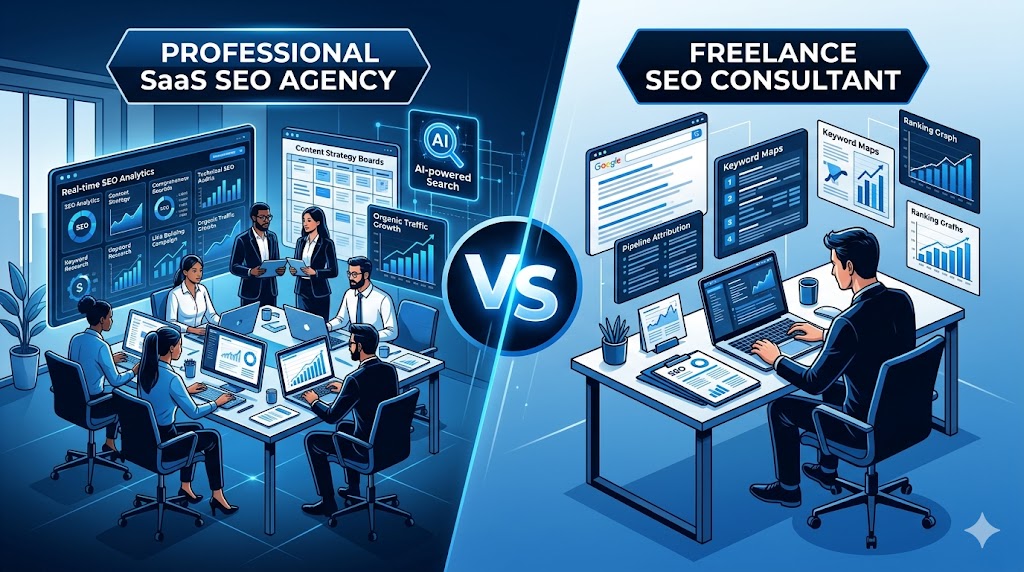
For SaaS companies, visibility in search engines is no longer optional. Whether you’re launching a new software product or scaling an established platform, organic search remains one of the most cost-effective channels for customer acquisition. However, when it comes to implementing a successful SEO strategy, many founders and marketing leaders face the same question: Should you hire a SaaS SEO agency or work with a freelancer?
At first glance, freelancers often appear more affordable and flexible. Agencies, on the other hand, bring larger teams, broader expertise, and established processes. But the decision isn’t simply about budget. It affects your ability to execute a long-term Organic Growth Strategy, improve Search Visibility, drive Qualified Lead Generation, and ultimately increase Monthly Recurring Revenue (MRR).
The reality is that modern SaaS SEO has evolved far beyond publishing blog posts and targeting a few keywords. Today’s competitive environment requires B2B SaaS SEO, sophisticated Keyword Intent Mapping, strategic Demand Generation, advanced technical optimization, and increasingly, AI Search Optimization and Generative Engine Optimization (GEO).
In this guide, we’ll break down the differences between a SaaS SEO Agency and a freelancer, compare their strengths and limitations, and help you determine which option aligns best with your business goals.
Understanding the Modern SaaS SEO Landscape
Before comparing an SEO Agency vs Freelancer, it’s important to understand what successful SaaS SEO looks like today.
Unlike traditional businesses, SaaS companies often have longer sales cycles and complex customer journeys. Prospects rarely convert after reading a single article. Instead, they move through multiple touchpoints across the SaaS Buyer Journey, consuming educational content, comparing solutions, signing up for free trials, and eventually becoming paying customers.
This means SEO must support every stage of the funnel through:
- Full-Funnel Content Marketing
- Search Intent Optimization
- Product-Led SEO
- Conversion-Focused SEO
- Demo Request Optimization
- Free Trial Sign-Ups
- Revenue Attribution Modeling
Successful SaaS SEO also requires a strong connection between marketing, product, sales, and customer success teams. SEO is no longer just a traffic channel; it has become a major contributor to SaaS Demand Generation and Organic Pipeline Growth.
As competition increases, companies need strategic execution across multiple disciplines rather than isolated SEO tasks.
What a SaaS SEO Agency Brings to the Table
A specialized SaaS SEO Agency offers a team-based approach designed specifically for software businesses.
Instead of relying on a single person, agencies often include:
- SEO strategists
- Content specialists
- Technical SEO experts
- Link-building professionals
- Analytics consultants
- Conversion optimization specialists
This collective expertise allows agencies to build comprehensive growth programs.
Strategic Planning and SEO Roadmapping
One major advantage is structured SEO Roadmapping.
Rather than focusing on short-term wins, agencies create long-term plans based on:
- Market positioning
- Audience research
- Competitor Analysis
- Revenue goals
- Funnel performance
These roadmaps help prioritize activities that contribute directly to business growth.
Technical Excellence
Many SaaS websites face complex technical challenges.
A dedicated agency can perform detailed Technical SEO Audits that uncover issues such as:
- Crawl inefficiencies
- Indexing problems
- Site architecture weaknesses
- JavaScript rendering issues
- Core Web Vitals concerns
Fixing these problems improves Search Visibility and supports sustainable Organic Traffic Growth.
Advanced Content Operations
Content remains the backbone of SaaS SEO.
Agencies build scalable Content Strategy frameworks that align with:
- User intent
- Product positioning
- Competitive gaps
- Revenue opportunities
Using detailed Keyword Intent Mapping, agencies ensure content targets users at every stage of the buying journey.
Instead of chasing traffic alone, they focus on attracting prospects who are likely to become customers.
Link Building and Authority Development
Strong Domain Authority continues to influence organic performance.
A SaaS agency often has dedicated outreach systems for:
- Digital PR
- Guest posting
- Industry partnerships
- Resource page placements
Effective Link Building strengthens authority and improves SERP Rankings for competitive SaaS keywords.
Where Freelancers Excel
Freelancers remain a popular option, especially for startups and early-stage SaaS businesses.
Hiring a freelancer can offer several benefits.
Lower Initial Investment
The most obvious advantage is cost.
A freelancer often charges less than an agency, making them attractive for companies with limited marketing budgets.
For startups trying to control Customer Acquisition Cost (CAC), this can be an important consideration.
Direct Communication
Working directly with one person simplifies communication.
There are fewer meetings, fewer approval layers, and faster decision-making.
This setup works well when founders want hands-on involvement in SEO execution.
Specialized Expertise
Some freelancers possess deep expertise in specific areas such as:
- Technical SEO
- Content creation
- Analytics
- SaaS SEO consulting
An experienced specialist can deliver excellent results within their niche.
However, challenges emerge when growth requires multiple skill sets simultaneously.
A single freelancer may struggle to handle:
- Content production
- Technical optimization
- Outreach campaigns
- Analytics reporting
- Conversion optimization
at scale.
SEO Agency vs Freelancer: A Detailed Comparison
Now let’s examine the core areas that matter most for SaaS growth.
Scalability and Resource Allocation
As SaaS companies grow, SEO requirements become more complex.
A freelancer has finite bandwidth.
An agency provides greater Scalability and Resource Allocation by assigning specialists based on project needs.
For example:
- Technical expert for audits
- Content strategist for planning
- Outreach specialist for backlinks
- Analyst for performance tracking
This flexibility becomes valuable when growth accelerates.
Winner: Agency
Content Production Capacity
Successful SaaS SEO requires a consistent publishing schedule.
Agencies can produce:
- Product pages
- Comparison pages
- Solution pages
- Industry guides
- Case studies
at scale while maintaining quality.
Freelancers may create excellent content but often face production limitations.
Winner: Agency
Strategic Demand Generation
Modern SEO is closely tied to Demand Generation.
Traffic alone is not enough.
Organizations need systems that generate:
- Qualified opportunities
- Pipeline growth
- Revenue impact
Agencies typically integrate SEO with broader Inbound Marketing Strategy initiatives, helping connect content performance to business outcomes.
Winner: Agency
Flexibility
Freelancers generally offer greater flexibility.
They can quickly adapt to changing priorities without navigating agency processes.
For startups experimenting with growth channels, this agility can be valuable.
Winner: Freelancer
Analytics and Attribution
Today’s SaaS leaders want to understand exactly how SEO impacts revenue.
Agencies often provide sophisticated:
- SEO Performance Reporting
- Pipeline Attribution
- Revenue Attribution Modeling
This level of analysis helps executives justify SEO investment and optimize marketing spend.
Winner: Agency
The Rise of AI Search and Why Expertise Matters More Than Ever
Search behavior is changing rapidly.
Traditional rankings remain important, but companies must also prepare for:
- AI-generated answers
- Search assistants
- Conversational search experiences
This shift has introduced new disciplines including:
Generative Engine Optimization (GEO)
Generative Engine Optimization (GEO) focuses on increasing brand visibility within AI-generated responses.
Instead of optimizing only for traditional rankings, GEO aims to position content as a trusted source for AI systems.
AI Search Optimization
AI Search Optimization extends SEO strategies into emerging search environments.
This includes:
- Structured data implementation
- Entity optimization
- Content authority development
- Semantic search alignment
Agencies often have dedicated teams researching these trends, while freelancers may struggle to keep pace with rapid industry changes.
For SaaS companies planning long-term growth, future-proofing SEO has become increasingly important.
Product-Led SEO and Revenue-Driven Growth
Many SaaS companies are embracing Product-Led SEO.
Rather than creating content disconnected from the product, product-led strategies align SEO efforts directly with user value.
Examples include:
- Feature pages
- Use-case pages
- Integration pages
- Templates
- Free tools
These assets help users discover the product naturally during their search journey.
Combined with Conversion-Focused SEO, companies can improve:
- Demo Request Optimization
- Free Trial Sign-Ups
- Product adoption
The ultimate goal is not traffic.
The goal is revenue.
This is where Revenue-Driven SEO becomes critical.
Rather than measuring success solely through rankings, revenue-driven teams focus on:
- Pipeline contribution
- Customer acquisition
- Revenue generation
- Retention impact
This approach aligns SEO with executive-level business objectives.
When a Fractional Marketing Team Makes Sense
Some SaaS companies find themselves between hiring a freelancer and engaging a full agency.
In these situations, a Fractional Marketing Team model can be effective.
This arrangement combines external specialists who work together on specific growth initiatives.
While this approach can reduce costs, it often requires significant management effort from internal stakeholders.
Businesses must coordinate:
- Content creation
- Technical implementation
- Reporting
- Strategy alignment
Without strong leadership, fragmented execution can slow results.
Understanding SEO Retainer Models
Most agencies operate using an SEO Retainer Model.
Rather than charging for isolated tasks, agencies provide ongoing services that evolve with business needs.
A retainer typically includes:
- Strategy development
- Technical optimization
- Content creation
- Link acquisition
- Performance monitoring
- Reporting
This model supports continuous growth rather than one-time improvements.
Freelancers may also offer retainers, but the scope is often narrower due to capacity limitations.
Which Option Is Best for Different Types of SaaS Companies?
Early-Stage Startups
A freelancer can be a good choice when:
- Budget is limited
- SEO needs are relatively simple
- Content volume requirements are low
However, founders should carefully evaluate expertise.
Growth-Stage SaaS Companies
An agency usually becomes the stronger option when:
- Organic traffic goals increase
- Competition intensifies
- Multiple stakeholders become involved
- Revenue targets become more aggressive
The combination of strategy, execution, and analytics often produces better long-term outcomes.
Enterprise SaaS Organizations
Enterprise businesses typically require agency support due to:
- Complex websites
- Large content operations
- International SEO requirements
- Advanced attribution needs
At this stage, scalability becomes essential.
The debate around SEO Agency vs Freelancer ultimately comes down to growth objectives, available resources, and organizational complexity.
A freelancer can provide valuable expertise, flexibility, and affordability for early-stage SaaS businesses. However, as companies scale, the demands of modern B2B SaaS SEO expand significantly. Technical optimization, strategic content creation, advanced attribution, authority building, and emerging practices such as Generative Engine Optimization (GEO) and AI Search Optimization require diverse skill sets that are difficult for one individual to deliver consistently.
A specialized SaaS SEO Agency offers a comprehensive approach that combines Technical SEO Audits, On-Page Optimization, Keyword Intent Mapping, Link Building, Programmatic SEO, Full-Funnel Content Marketing, and sophisticated SEO Performance Reporting into a unified growth engine.
If your goal is sustainable Organic Traffic Growth, improved SERP Rankings, stronger Search Visibility, lower Customer Acquisition Cost (CAC), increased Qualified Lead Generation, and higher Monthly Recurring Revenue (MRR), partnering with the right agency often provides the infrastructure needed for long-term success.
The best choice is not necessarily the cheapest option—it is the one that aligns SEO efforts with measurable business outcomes and turns organic search into a predictable source of revenue growth.
Why Choose RankingPire for SaaS SEO?
In today’s competitive digital landscape, SaaS companies need more than just traffic—they need qualified leads, predictable pipeline growth, and measurable revenue. RankingPire helps businesses achieve these goals through data-driven SEO strategies designed specifically for long-term growth.
1. Specialized SaaS SEO Expertise
RankingPire understands the unique challenges of SaaS businesses, including long sales cycles, complex buyer journeys, and recurring revenue models. Our strategies are tailored to drive qualified traffic that converts into customers.
2. Revenue-Focused SEO Approach
We don’t focus solely on rankings. Our SEO campaigns are built around business outcomes such as lead generation, demo requests, free trial sign-ups, pipeline growth, and increased Monthly Recurring Revenue (MRR).
3. Comprehensive SEO Solutions
From technical SEO audits and on-page optimization to content strategy, keyword research, and link building, RankingPire provides end-to-end SEO services under one roof.
4. Data-Driven Decision Making
Every recommendation is backed by analytics, competitor research, search intent analysis, and performance data to ensure maximum ROI from your SEO investment.
5. Full-Funnel Content Strategy
Our team creates content that supports every stage of the customer journey—from awareness and consideration to conversion and retention—helping businesses generate consistent organic leads.
6. Advanced Technical SEO Expertise
We identify and resolve technical issues that may be limiting your search visibility, improving website performance, crawlability, user experience, and search rankings.
7. Transparent Reporting
RankingPire provides clear and actionable reporting, allowing clients to track keyword growth, organic traffic, conversions, lead generation, and revenue impact with confidence.
8. Scalable Growth Strategies
Whether you’re a startup looking for initial traction or an established SaaS company seeking market leadership, our SEO strategies are designed to scale alongside your business.
9. Future-Ready SEO
With the rise of AI-powered search, we incorporate AI Search Optimization and Generative Engine Optimization (GEO) strategies to help businesses stay ahead of evolving search trends.
10. Dedicated Growth Partner
At RankingPire, we work as an extension of your team. Our goal is not just to improve rankings but to help you build a sustainable organic growth engine that drives long-term business success.

FAQs
1. What is a SaaS SEO agency?
A SaaS SEO agency specializes in helping software companies improve organic visibility, generate qualified leads, and increase recurring revenue through tailored SEO strategies.
2. What does a SaaS SEO freelancer do?
A SaaS SEO freelancer provides independent SEO services such as keyword research, content optimization, technical SEO, and link building for SaaS businesses.
3. What is the difference between a SaaS SEO agency and a freelancer?
An agency offers a team of specialists covering multiple SEO disciplines, while a freelancer is usually a single expert handling selected SEO tasks.
4. Which is more cost-effective: an SEO agency or a freelancer?
Freelancers are generally less expensive upfront, while agencies often provide greater long-term value through comprehensive services and scalable execution.
5. Is a SaaS SEO agency worth the investment?
Yes, especially for growth-stage and enterprise SaaS companies that need advanced SEO strategies, reporting, and scalable execution.
6. When should a SaaS startup hire a freelancer?
Startups with limited budgets and straightforward SEO needs may benefit from hiring an experienced SaaS SEO freelancer.
7. How does B2B SaaS SEO differ from traditional SEO?
B2B SaaS SEO focuses on longer sales cycles, complex buyer journeys, lead generation, and revenue-focused optimization strategies.
8. What is Product-Led SEO?
Product-Led SEO creates content and landing pages directly tied to product features, use cases, integrations, and customer problems.
9. Why is keyword intent mapping important in SaaS SEO?
Keyword intent mapping helps align content with user needs at different stages of the SaaS buyer journey, improving conversions and engagement.
10. What are technical SEO audits?
Technical SEO audits identify website issues affecting crawling, indexing, site speed, user experience, and search engine performance.
11. How important is content strategy for SaaS SEO?
Content strategy is essential because it guides content creation around customer pain points, search intent, and revenue opportunities.
12. What role does link building play in SaaS SEO?
Link building improves domain authority, increases trust signals, and helps websites rank higher for competitive keywords.
13. What is programmatic SEO?
Programmatic SEO uses automation and templates to create large numbers of targeted pages efficiently.
14. What is Generative Engine Optimization (GEO)?
GEO focuses on optimizing content so it appears in AI-generated search results and conversational AI responses.
15. What is AI Search Optimization?
AI Search Optimization helps businesses improve visibility across AI-powered search engines and answer platforms.
16. Can SEO improve monthly recurring revenue (MRR)?
Yes. Effective SEO drives qualified traffic, leads, and customers that contribute directly to recurring revenue growth.
17. What is demand generation in SaaS?
Demand generation involves creating awareness and interest that ultimately drives leads, opportunities, and sales.
18. How does SEO support qualified lead generation?
SEO attracts users actively searching for solutions, increasing the likelihood of generating high-intent leads.
19. What is conversion-focused SEO?
Conversion-focused SEO prioritizes actions such as demo requests, free trial sign-ups, and sales inquiries rather than traffic alone.
20. Why is pipeline attribution important?
Pipeline attribution helps businesses understand how SEO contributes to sales opportunities and revenue generation.
21. What is revenue-driven SEO?
Revenue-driven SEO focuses on metrics tied to business growth, such as revenue, pipeline, and customer acquisition rather than rankings alone.
22. How long does SaaS SEO take to show results?
Most SaaS companies begin seeing meaningful results within 3–6 months, with significant growth often occurring between 6–12 months.
23. What is an SEO retainer model?
An SEO retainer model involves ongoing monthly SEO services including strategy, optimization, content creation, and reporting.
24. How does SEO reduce customer acquisition cost (CAC)?
Organic traffic reduces reliance on paid advertising, lowering the overall cost of acquiring customers.
25. What is search intent optimization?
Search intent optimization ensures content matches what users are actually looking for when they perform a search.
26. Why is competitor analysis important in SaaS SEO?
Competitor analysis reveals keyword opportunities, content gaps, backlink prospects, and market positioning insights.
27. What metrics should SaaS companies track for SEO success?
Key metrics include organic traffic, keyword rankings, conversions, pipeline contribution, CAC, MRR, and revenue attribution.
28. Can SEO help increase free trial sign-ups?
Yes. Optimized landing pages and targeted content can attract high-intent users and encourage trial registrations.
29. What is full-funnel content marketing?
Full-funnel content marketing creates content for awareness, consideration, and decision-making stages of the customer journey.
30. How do I choose the right SaaS SEO partner?
Evaluate industry experience, case studies, technical expertise, reporting capabilities, communication style, and proven results before making a decision.
Also Read: SaaS marketing agency vs freelancer
